14 October 2026
Collective center or self-settled camp? Reading camp typology from overhead imagery
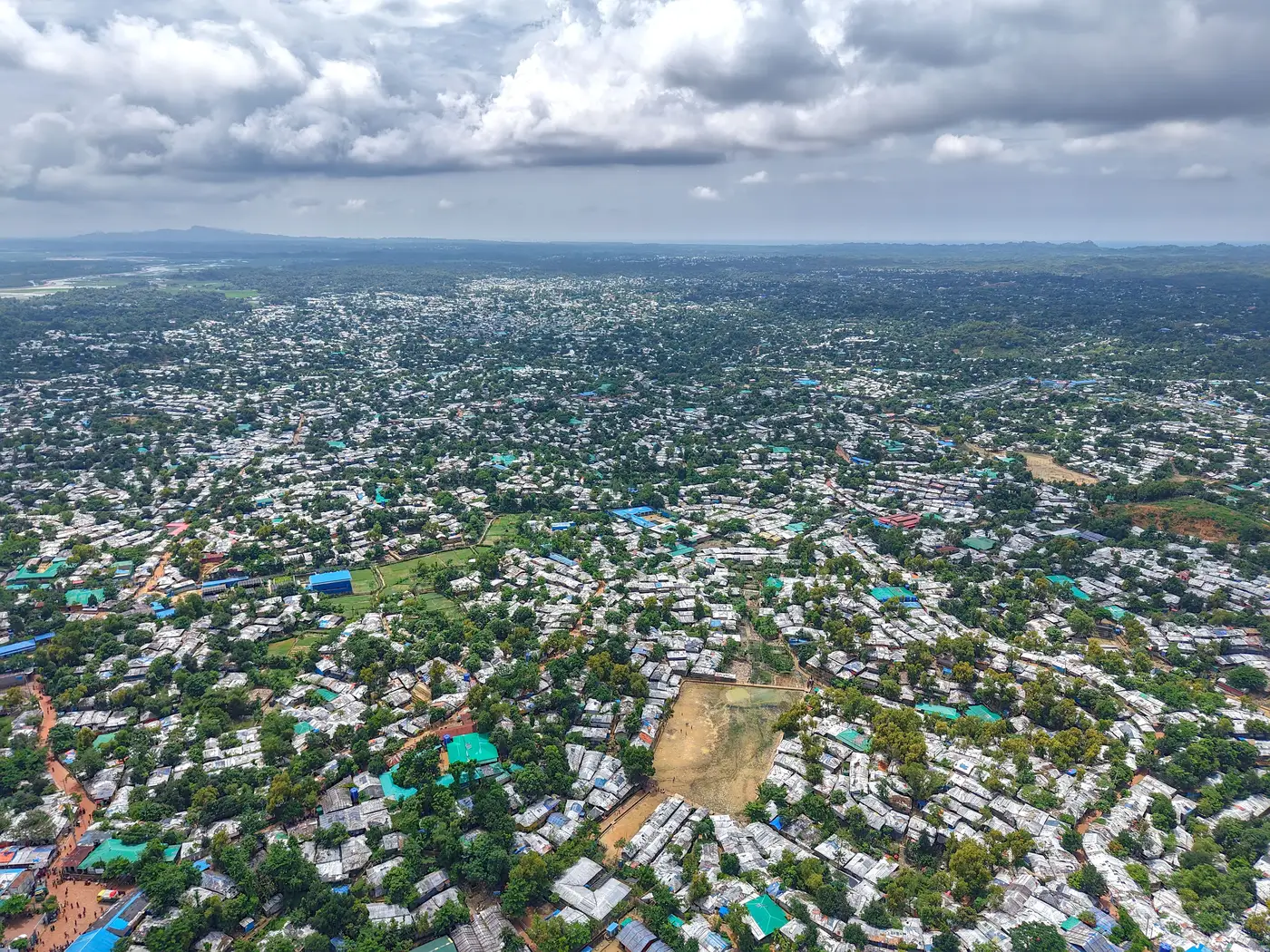
In registration data and even first-hand reports, these two terms get blurred together. When you're sizing a response off imagery before anyone has walked the site, knowing which one you're looking at changes your planning numbers. A collective center at capacity reads as a fixed number of households inside one building's footprint. A self-settled camp is open-ended, and keeps adding structures as word spreads that a route or a border crossing is safe.
Start with the base layer: is there already a building there
A collective center sits on something that existed before the crisis: a school with a flat or pitched roof, a warehouse with a long shed roof, a stadium, an unfinished apartment block. Look at the roofline. In VHR imagery under 0.5 m you can usually resolve roof seams, vents, even the shadow line of an overhang. If the footprint has straight edges and a roof texture consistent with a permanent structure, that's your building. Around it, people are using the grounds, a courtyard, a parking lot, an athletic field, for latrines, water points, maybe a few lean-to shelters built off the exterior wall. But the household count is capped by the building shell, not by how far the tarps spread.
A self-settled camp has no base building, or only one or two nearby. What you see instead is tents and makeshift shelters sitting directly on open ground, a fallow field, a roadside verge, a riverbank, an unused lot, each one its own small footprint. Spacing is uneven, with worn paths between shelters rather than engineered rows. Materials vary: plastic sheeting catches light differently than canvas, scrap tin roofing reflects differently again. A mixed-material texture across the cluster is itself a signal you're not looking at a single repurposed structure.
Watch how the footprint moves week to week
A single image stops being enough once you need a growth trend, and this is where the comparison across dates starts to matter. A collective center's footprint is nearly static. The building doesn't grow, but the density of use around it can climb fast. If the shelter footprint outside the building expands week over week, that's an overflow site attached to a collective center, and worth flagging as its own planning case.
A self-settled camp's footprint is the thing that actually moves. New tents appear at the edges, along access tracks, pushing into adjacent fields, and this growth is often the first hard evidence that a displacement event is still unfolding rather than a one-time arrival. Counting new structures against last week's baseline gives a more current read on population growth than waiting on a registration update, because a registration figure lags arrival by days or weeks while the imagery shows the tents as they go up.
A mixed site is usually the honest answer
In practice, a lot of sites are a collective center that has overflowed into a self-settled annex. A school fills up, then families start pitching tarps on the playing field beside it. Call this what it is, two typologies occupying one location, and size capacity for each separately rather than averaging them into one number. Lumping them together is how a shelter plan ends up short on one end and oversupplied on the other.
Why the distinction matters for sizing
A camp planning officer pricing out latrines, water trucking, and shelter kits needs different unit assumptions for each type. Collective center planning is bounded by a structure's capacity and sanitation load per square meter of covered space. Self-settled camp planning has to assume continued arrivals and reserve expansion land, because the footprint you see today is a floor, not a ceiling.
Weekly structure counts broken out as new shelters against a prior baseline give you the growth curve for self-settled sites and the overflow trend around collective centers, without waiting on a field team to get there. That's the gap Displacement Monitoring is built to close, so take a look next time you need a number before the report is due.